
Before a human being is placed inside an extreme environment suit, a specific set of questions must have documented answers. Not estimated answers, not modelled answers alone, but measured answers from a controlled test article under representative conditions. The test bench is the instrument that produces them.
This article sets out what those questions are and what a bench needs to be capable of in order to answer them.
THE PRE-HUMAN-TRIAL CHECKLIST
Nine validations should be complete before an operator enters the suit under test conditions.
- Pressure integrity across the full operating range, including proof pressure with margin and leak rate at operating pressure.
- Failure mode characterisation for every pressure-bearing element, establishing whether failures are gradual or sudden.
- Thermal envelope, both the suit's ability to maintain a habitable microclimate and the temperature of every surface in contact with the wearer.
- Breathing gas supply integrity, including flow rate under maximum demand, carbon dioxide removal capacity and contamination control.
- Emergency egress time from the fully assembled and pressurised configuration, with and without assistance.
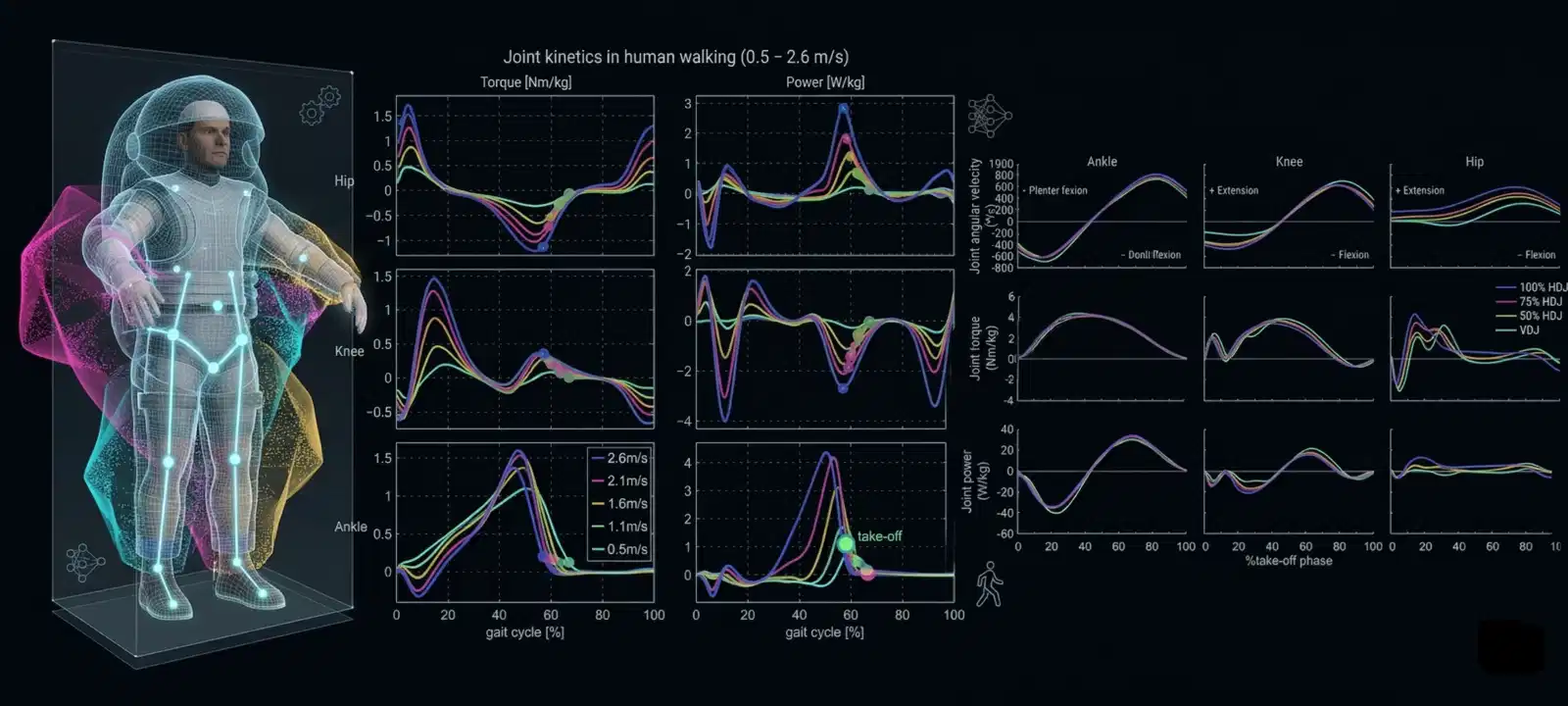
- Mobility torque at every joint across the pressure range, quantifying the metabolic cost the wearer will incur.
- Sensor and instrumentation accuracy under the environmental envelope, not bench conditions.
- Electrical safety including isolation, fault current paths and behaviour under moisture ingress.
- Materials compatibility with skin contact, decontamination agents and the mission atmosphere.
Any of these outstanding is a reason to delay human exposure. All nine complete does not guarantee safety, but their absence guarantees that safety has not been established.
BENCH ARCHITECTURE
Environmental generation
The bench must produce the mission environment with controlled ramp rates. Steady-state generation is comparatively easy; controlled transients are where the engineering effort goes, and transients are where most failures occur. A chamber that can hold vacuum but cannot execute a specified decompression profile cannot validate the case that matters.
Load application
Mechanical loading must be representative of use rather than convenient to apply. Cyclic flexure at joints, abrasion at contact points, and combined pressure-plus-motion loading reproduce the conditions that produce wear failures. Static hold tests are necessary but not sufficient.
Instrumentation
The bench's own instrumentation determines the resolution of everything it can detect. Sampling rates must exceed the dynamics of the failure modes being investigated, which requires knowing those dynamics in advance. Calibration must be traceable, and calibration intervals must be short enough that drift between calibrations is smaller than the effects being measured.
Configuration control
The bench is itself a test article. Changes to fixtures, instrumentation, software and setup must be documented and versioned, or results across a campaign are not comparable. This is the most commonly neglected element and the one that most often invalidates a data set retrospectively.
THE SURROGATE AS BENCH COMPONENT
A bench that applies environmental conditions to an empty suit answers equipment questions. A bench with an instrumented human surrogate inside the suit answers human systems questions, which is a substantially larger and more useful set.
A surrogate that reproduces joint kinematics enables mobility torque measurement under realistic articulation. One that generates metabolic heat enables thermal balance measurement under realistic loading. One that reproduces respiratory volumes enables life support capacity measurement under realistic demand. And one instrumented at points a human cannot be instrumented enables measurement that human trials cannot produce.
The surrogate also removes the ethical constraint that shapes human trial design. Testing to failure, holding extreme conditions for extended periods, and repeating identical exposures dozens of times are all straightforward with a surrogate and impossible with a person.
MODEL-IN-THE-LOOP
The most efficient benches run predictive models alongside the physical test in real time. This converts each test from a measurement into a comparison, which produces more information per run.
When measurement matches prediction within tolerance, the model's validated envelope extends and future cases within that envelope need not be physically tested. When measurement diverges, the divergence localises the problem: either the model is wrong about the physics, or the hardware is not behaving as designed. Both are useful findings, and neither is available from measurement alone.
This is the same hardware-in-the-loop philosophy that aerospace integration rigs have used for decades, where real components are connected to a simulated environment so that hardware and software behaviour can be tested together under conditions that would be impractical to create physically.
SAFETY DESIGN OF THE BENCH ITSELF
Once human trials begin, the bench becomes a life-critical system and must be engineered as one. This means independent emergency shutdown with a path that does not depend on the primary control system, continuous monitoring by qualified personnel with clearly defined abort authority, pre-defined abort criteria that are not subject to negotiation during a run, medical support proportionate to the risk profile, and communication with the test subject that survives failure of the primary system.
Abort authority deserves particular attention. The person with authority to stop a test must be someone with no stake in its completion, or the authority is nominal. Programmes under schedule pressure discover this distinction expensively.
TEST BENCH ECONOMICS
Bench infrastructure has a poor superficial business case. It is capital-intensive, produces no product revenue, and requires ongoing calibration and maintenance expenditure. Three factors change the calculation.
First, iteration speed. In-house bench capacity means a design change can be tested the same week rather than when external facility time becomes available, which compounds over a development programme into a substantial schedule advantage.
Second, defect economics. A failure mode found on the bench costs a test article. The same failure found in human trials costs a programme pause, an investigation, and potentially a regulatory relationship.
Third, service revenue. Mature bench capability can be offered to others in the sector, converting a cost centre into revenue and building relationships with organisations that are future customers or partners. This is a meaningful part of the case for treating validation infrastructure as a business line rather than an overhead.
INSTRUMENTATION PLANNING
Instrumentation is the element that most often constrains what a bench can discover, and it needs to be planned from the failure modes backward rather than from available sensors forward.
Start by listing the failure modes the bench must detect. For each, identify the physical quantity that changes, the magnitude of the change, and the timescale over which it occurs. Sampling rate must exceed the dynamics of the fastest failure mode of interest by a comfortable margin, and resolution must be finer than the smallest change that matters.
Then work out what cannot be measured directly and must be inferred. Seal integrity, for example, is usually inferred from pressure decay rather than measured. The inference chain should be documented, because a reviewer will ask how a claimed measurement was actually obtained.
Plan for redundancy on the channels that matter most. A single-channel measurement that disagrees with expectation is ambiguous: either the article or the sensor is at fault. Two independent measurement paths resolve that ambiguity immediately and are worth the additional cost on any safety-critical channel.
Finally, budget for calibration. Instrumentation calibration is recurring operational expenditure, not a one-time setup cost, and benches whose calibration lapses produce data that cannot be defended retrospectively.
THE STANDARD TO HOLD
A well-designed test bench should allow an independent engineer, given only the documentation, to reproduce any result in the campaign. If that is not achievable, the bench is producing demonstrations rather than evidence, and the distinction will become apparent at exactly the wrong moment in a qualification review.
FREQUENTLY ASKED QUESTIONS
What must be validated before a human enters an extreme environment suit?
Pressure integrity with margin, failure mode characterisation for pressure-bearing elements, thermal envelope including contact surface temperatures, breathing gas supply integrity under maximum demand, emergency egress time from the pressurised configuration, mobility torque across the pressure range, instrumentation accuracy under the environmental envelope, electrical safety including moisture ingress behaviour, and materials compatibility.
What makes a test bench scientifically valid?
Controlled ramp rates rather than steady-state generation alone, representative rather than convenient load application, sampling and resolution exceeding the dynamics of the failure modes being investigated, traceable calibration, and configuration control on the bench itself so that results across a campaign remain comparable.
Who should hold abort authority during human trials?
Someone with no stake in the test's completion. Abort criteria should be defined before the run and not subject to negotiation during it, with an emergency shutdown path independent of the primary control system. Where abort authority sits with the person responsible for schedule, the authority is nominal.
References
- Metakosmos - PROVE
- Metakosmos - SUITRIX
- Metakosmos - SYNHUM
- Metakosmos - SYNSUIT
- Metakosmos - CORE
- Metakosmos - DEPLOY
- SAE International - AIR5992 systems integration test rigs (Iron Birds)
- NASA - X-59 ground systems testing
- NASA - NASA-STD-3001 Volume 2
- ASTM International - F739 permeation test method
- NASA HRP - Human Health and Countermeasures evidence report
Explore SUITRIX test rigs and the PROVE validation apparatus
Explore SUITRIX test rigs and the PROVE validation apparatus at metakosmos.co/prove/suitrix.