
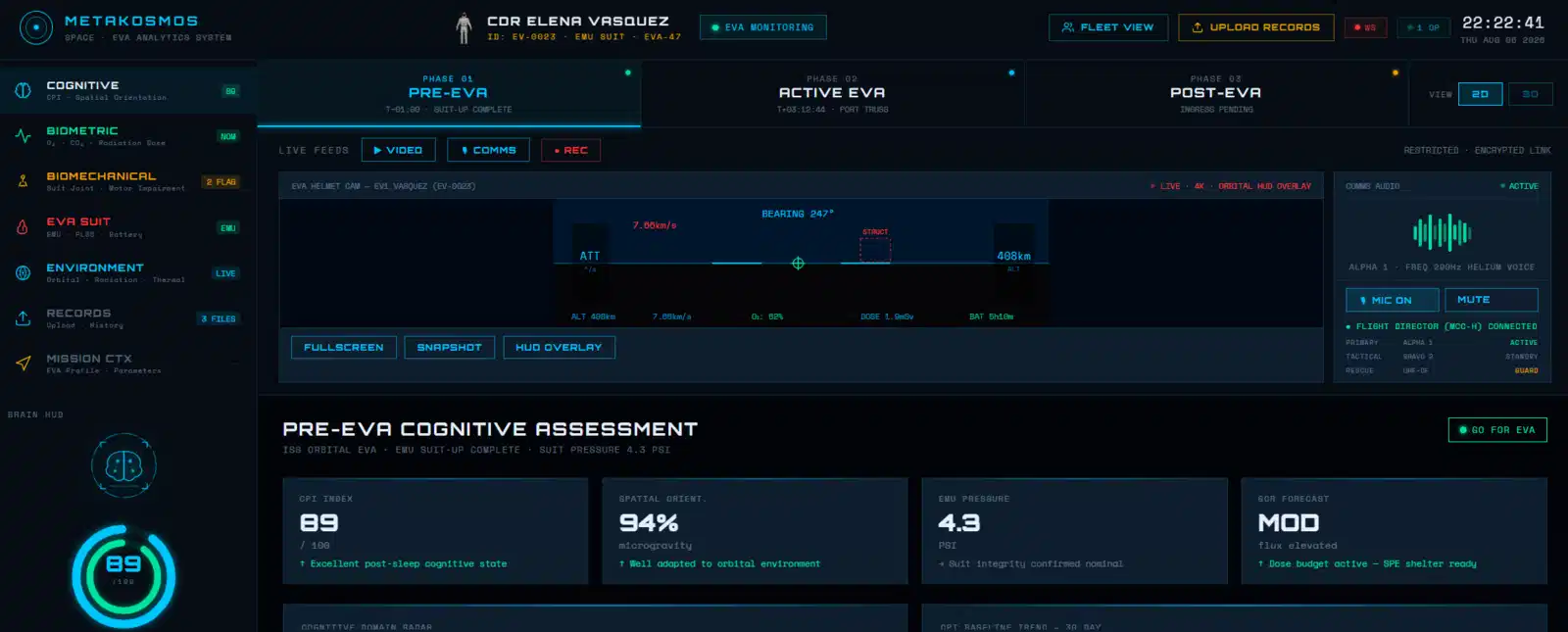
A protective suit without telemetry tells you one thing after a mission: whether it failed. A suit with telemetry tells you, during the mission, how close it is to failing, how the operator inside is coping, and how much margin remains before a decision has to be made. That difference is the entire value proposition of suit telemetry systems.
The engineering behind that difference is considerably less glamorous than the pitch, and understanding it properly is what separates a deployable system from a demonstration.
THREE STREAMS, ONE PIPELINE
Suit telemetry is not a single data type. It is the fusion of three distinct streams with different sampling rates, different reliability requirements and different consumers.
Physiological telemetry
This stream describes the operator: ECG and heart rate variability, core and skin temperature, blood oxygen saturation, respiration rate, hydration proxies, motion and posture, and derived indicators such as fatigue and cognitive load. It samples fast, tolerates gaps poorly, and its primary consumer is the safety decision-maker.
Environmental telemetry
This stream describes the world outside the barrier: ambient temperature and humidity, atmospheric pressure, radiation dose rate, toxic agent presence, air quality and depth or altitude. It typically samples slower, but its data has legal and medical significance because it establishes exposure records.
Suit engineering telemetry
This stream describes the equipment: internal pressure, seal integrity, ventilation flow, power state, consumable levels and subsystem health. It is the least discussed and often the most operationally valuable, because equipment degradation usually precedes physiological distress.
The architectural challenge is that these three streams must be time-aligned to a common clock and fused into a single operator state before they are useful. A heart rate spike means one thing during heavy exertion and something entirely different at rest in a rising thermal environment.
WHY SENSOR SELECTION IS HARDER THAN IT LOOKS
The consumer wearables market has made physiological sensing look solved. It is not solved for extreme environments, for four reasons that recur across every domain.
- Motion artefact. Optical heart rate sensors degrade badly under vibration, impact and heavy exertion, exactly the conditions where the reading matters most.
- Perfusion changes. Peripheral sensing depends on blood flow to the extremities, which is precisely what the body reduces under cold stress, high-G loading and dehydration.
- Barrier integration. Any sensor that penetrates a CBRN barrier, a pressure bladder or a hydrostatic shell creates a potential failure path that must be qualified.
- Environmental envelope. A sensor rated for consumer use will not survive the thermal, pressure or chemical exposure that the suit exists to protect against.
The practical consequence is that sensor placement, redundancy and cross-validation matter more than raw sensor specification. A system that derives core temperature from two independent methods and flags disagreement is more useful operationally than one with a single higher-accuracy sensor.
EDGE, RIG AND CLOUD: WHERE PROCESSING HAPPENS
Bandwidth in extreme environments is scarce and often intermittent. A diver at depth, an EVA crew member behind a vehicle, a CBRN team inside a structure and a pilot in a contested electromagnetic environment all face the same constraint: the link will drop, and the system must remain useful when it does.
This drives a three-tier processing architecture. Edge processing on the suit itself handles sampling, local fusion, anomaly detection and alerting, and must function fully offline. Rig or gateway processing at the dive control station, vehicle, command post or airlock handles team-level aggregation, cross-operator comparison and buffering during link outages. Cloud or ground processing handles long-horizon analytics, model training, exposure records and post-mission reconstruction.
A system that only works when connected is not a telemetry system. It is a dashboard.
FROM DATA TO DECISION
Raw telemetry has almost no operational value. The value is created when data becomes a decision with a defined threshold and a defined action. This is where most telemetry programmes fail: they deliver visibility without defining what visibility triggers.
Established occupational health frameworks provide a starting point. The NIOSH criteria for occupational exposure to heat and hot environments set out physiological monitoring approaches and the effects of protective clothing on heat exchange, providing defensible thresholds for heat strain in encapsulating garments. In diving, the US Navy Diving Manual codifies decompression obligations and physiological limits that telemetry can track against in real time rather than by table lookup.
The engineering discipline here is to define the alert taxonomy before building the interface. Advisory alerts inform. Caution alerts require acknowledgment. Warning alerts require an action within a defined window. Abort criteria are non-negotiable. A system that presents all four in the same visual language will be ignored within a week of deployment.
DOMAIN VARIANTS AND WHAT CHANGES BETWEEN THEM
The architecture is common. The tuning is not. Pulse.Land prioritises heat strain, toxic exposure and cognitive load for CBRN, polar and tactical operators. Pulse.Sea prioritises depth, dissolved gas tracking, thermal loss and cognitive impairment for divers. Pulse.Air prioritises G-tolerance, blood oxygen saturation and hypoxia onset for aircrew. Pulse.Space prioritises consumables, suit pressure integrity and EVA metabolic rate. Pulse.Joint fuses all four for multi-domain operations.
What stays constant across variants is the data schema, the time base, the alert taxonomy and the analytics stack. What changes is which signals are promoted to primary display, what thresholds apply, and what actions the alerts demand.
VALIDATION: THE PART BUYERS SHOULD INTERROGATE
A telemetry claim is only as good as its calibration and validation evidence. The questions that separate credible systems from optimistic ones are specific.
- Against what reference was each sensor calibrated, and how often is calibration re-verified?
- What is the measured accuracy under the environmental envelope, not the bench specification?
- What is the false positive and false negative rate for each alert class, and how was it established?
- How does the system behave during link loss, sensor failure and power degradation?
- What evidence exists from testing on human surrogates and in field-deployed validation platforms rather than laboratory volunteers?
Systems that can answer these questions with documentation are ready for procurement conversations. Systems that answer with a demonstration video are not.
BUILDING THE ALERT TAXONOMY
The most common reason telemetry deployments fail operationally is not measurement accuracy. It is alert design. Systems that generate too many alerts are silenced; systems that generate too few are not trusted. The correction is a formal taxonomy defined before any interface is built.
A workable four-tier structure separates advisory notifications, which inform without requiring response, from cautions that require acknowledgment, warnings that require an action within a stated window, and abort criteria that are non-negotiable and pre-authorised. Each tier should have a distinct visual and auditory signature so that an operator can classify without reading.
Every alert in the taxonomy needs four defined attributes: the condition that triggers it, the measurement and threshold that detect it, the required response, and the false positive rate established during validation. An alert without a documented false positive rate cannot be tuned, and an alert without a defined required response is an interruption rather than information.
Field experience across defence and industrial deployments is consistent on one point: it is better to launch with fewer alerts at high confidence and add more as validation data accumulates, than to launch comprehensive and lose operator trust in the first month.
THE DIRECTION OF TRAVEL
Suit telemetry is following the same trajectory that aircraft health monitoring followed forty years ago: from post-incident forensics, to real-time monitoring, to predictive maintenance, to autonomous protective action. Most operational systems today sit at stage two. The organisations that reach stage three first will do so because they invested in the validation and data schema work that makes prediction trustworthy, not because they added more sensors.
FREQUENTLY ASKED QUESTIONS
What data do suit telemetry systems capture?
Three fused streams. Physiological data covers ECG, heart rate variability, core and skin temperature, blood oxygen saturation, respiration and hydration proxies. Environmental data covers temperature, pressure, radiation dose, toxic agent presence and depth or altitude. Suit engineering data covers internal pressure, seal integrity, ventilation flow, power state and consumable levels.
Do suit telemetry systems work without connectivity?
Well-designed systems do. The edge tier running on the suit must handle sampling, local fusion, anomaly detection and operator alerting entirely offline, buffering data for later transmission. A system whose safety alerting depends on an active link has no safety alerting in the environments where links most often fail.
How accurate is physiological monitoring in extreme environments?
Less accurate than consumer specifications suggest. Optical sensors degrade under vibration and impact, peripheral sensing degrades under cold-induced vasoconstriction and dehydration, and calibration drifts with temperature. Credible systems use redundant measurement paths and cross-validation, and publish accuracy figures measured under the operational envelope rather than on the bench.
References
- Metakosmos - PULSE
- Metakosmos - Land
- Metakosmos - Sea
- Metakosmos - Air
- Metakosmos - Space
- Metakosmos - PULSE Joint
- Metakosmos - SYNHUM
- Metakosmos - HELIOS
- NIOSH - Criteria for a Recommended Standard: Occupational Exposure to Heat and Hot Environments
- NAVSEA - US Navy Diving Manual, Revision 7
- NASA - Human Spaceflight and Aviation Standards
- NASA Human Research Program
- OSHA - Heat exposure resources and monitoring guidance
Explore PULSE telemetry and performance intelligence
Explore PULSE telemetry and performance intelligence at metakosmos.co/pulse.