
The US Extravehicular Mobility Unit operates at 4.3 psi. That single number drives most of what follows in spacesuit design: how long a crew member can work before injury, how many hours of oxygen prebreathe a spacewalk requires, and how much energy is spent deforming the garment rather than doing the task.
Understanding why that pressure figure is so constraining, and what raising it would require, separates an informed buyer from one who will be sold a rebadged pressure garment.
THE PRESSURE PROBLEM THAT DEFINES EVERYTHING
The figure is low enough to keep the garment flexible, and it is the reason astronauts must undergo lengthy oxygen prebreathe protocols before every spacewalk to purge dissolved nitrogen and avoid decompression sickness when transitioning from the station's 14.7 psi cabin.
NASA's Human Research Program has documented the consequences in detail. The pressurised EMU forces the astronaut to expend energy deforming the suit against internal pressure, which limits mobility and contributes to a well-catalogued set of musculoskeletal injuries, with hand and finger injuries the most common during both training and flight. Meanwhile the standard resting prebreathe protocol requires four hours of breathing pure oxygen before an EVA that may itself last eight hours, producing a crew duty day beyond fourteen hours.
Every serious next-generation suit programme is an attempt to attack one or both sides of this equation: raise operating pressure to shorten prebreathe without destroying mobility, or redesign the joint architecture so that higher pressure costs less metabolic work.
DESIGN PRIORITY ONE: JOINT ARCHITECTURE AND MOBILITY
Mobility in a pressurised garment is a volume-constancy problem. A pressurised bladder resists any motion that changes its enclosed volume, so a joint that maintains constant volume through its range of motion requires almost no torque to move. Convolute joints, rolling-convolute bearings, and hard-mounted rotational bearings are all approaches to this problem, each with different mass, wear and failure-mode characteristics.
The programmes now flying illustrate the direction. NASA's Artemis surface suit, the Axiom Extravehicular Mobility Unit, builds on the agency's earlier xEMU work and introduces a rear-entry hatch design, a wider anthropometric accommodation range and mobility improvements specifically targeted at lunar surface work, where crews must kneel, walk on slopes and handle tools rather than perform station-keeping tasks on handrails.
For buyers evaluating suit hardware architecture, the questions are concrete: what is the measured torque at each joint across the pressure range, how does it degrade with cycle count, and how was that measured?
DESIGN PRIORITY TWO: THERMAL CONTROL ACROSS EXTREME FLUX
Thermal management in vacuum is harder than in any terrestrial environment because conduction and convection to the surroundings are effectively absent. Heat rejection is radiative or through consumables. On the lunar surface, direct sunlight and permanently shadowed regions can differ by hundreds of degrees, and a suit must maintain a habitable microclimate across both while dissipating metabolic heat that varies by a factor of five between rest and heavy work.
Liquid cooling and ventilation garments remain the dominant solution, but the control logic is where the remaining gains sit. A thermal system that responds to measured operator core temperature and metabolic rate rather than a fixed setpoint will consume fewer consumables and produce better performance, which is precisely where the telemetry layer stops being a nice-to-have and becomes a life support subsystem.
DESIGN PRIORITY THREE: THE INSTRUMENTATION LAYER
This is the genuine generational difference. Apollo and Shuttle-era suits carried minimal biomedical instrumentation. A next-generation suit is an instrumented platform, and the telemetry and performance intelligence layer is a design constraint on the hardware rather than an accessory bolted on afterwards.
A modern instrumentation stack spans three categories. Physiological sensing covers ECG, heart rate variability, core and skin temperature, blood oxygen saturation, respiration and hydration proxies. Environmental sensing covers suit internal pressure, external pressure, radiation dose, thermal flux and contamination. Suit engineering telemetry covers seal integrity, power state, consumable levels, ventilation flow and subsystem health.
The design implications are significant. Sensors need power, data paths, thermal isolation and mounting that does not create pressure points or compromise the pressure bladder. Getting this right requires the instrumentation to be specified at the same time as the pressure architecture, not retrofitted.
DESIGN PRIORITY FOUR: VALIDATION BEFORE HUMAN TRIALS
The most consequential shift in next-generation suit development is not in the garment at all. It is in how the garment is proven. Human-rating a life-critical system requires an evidence chain that traces from requirement through test to acceptance, and increasingly that chain begins long before a human is inside the suit.
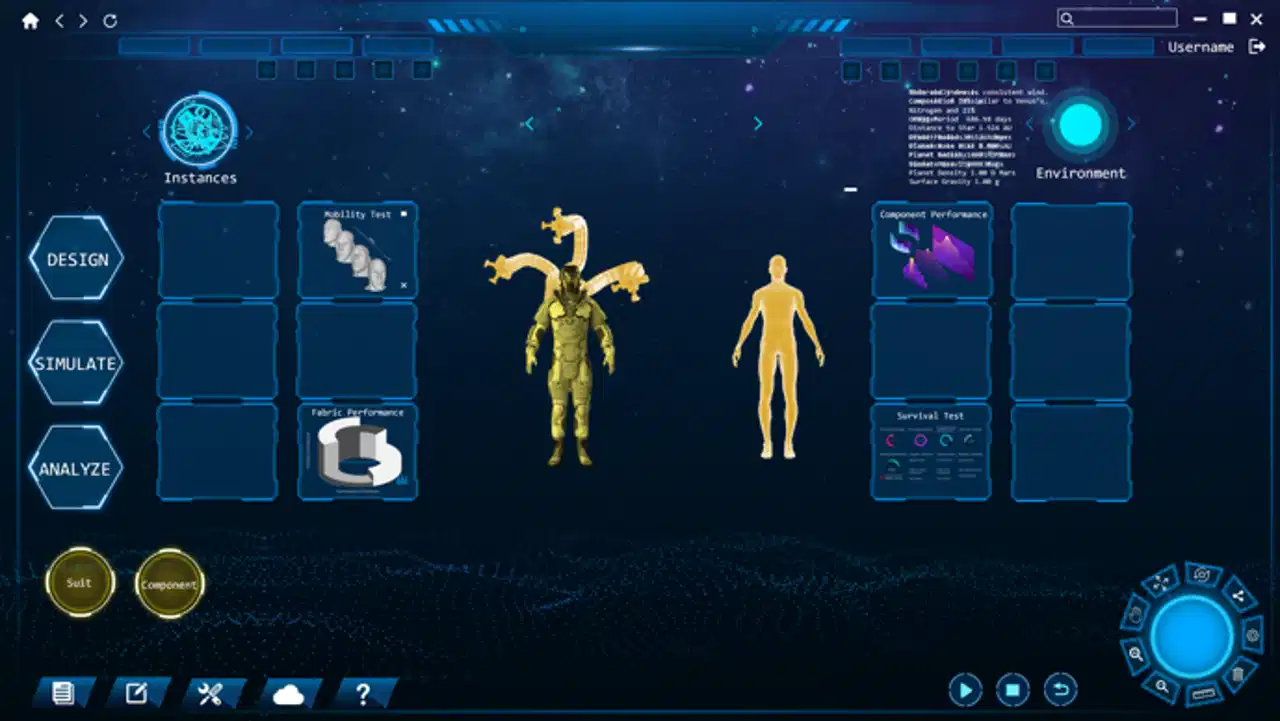
Three complementary methods do this work. Test rigs reproduce mission conditions on the ground, so pressure, thermal, vacuum and mechanical loading can be applied repeatably. Human surrogates instrumented to represent biomechanics and physiology generate measurement without placing an operator at risk. Digital twin environments predict what both should produce, so divergence between prediction and measurement becomes a diagnostic signal rather than a surprise. The Metakosmos PROVE validation apparatus is built around exactly this three-part structure.
NASA's own qualification approach reflects the same philosophy. AxEMU development has included pressurised underwater testing at the Neutral Buoyancy Laboratory, thermal vacuum chamber campaigns, and elevated suit pressure trials evaluating crew task performance at different pressure levels - each generating evidence against a specific requirement rather than a general demonstration of capability.
THE STANDARDS LAYER
Next-generation suit programmes do not operate in a regulatory vacuum. NASA-STD-3001 Volume 2 explicitly covers suits as part of its scope for human-rated systems, defining requirements for human physical and cognitive capabilities across all mission phases. The companion Human Integration Design Handbook provides the interpretive guidance that turns requirements into design decisions.
For commercial developers, engaging with this standards architecture early is far cheaper than retrofitting compliance. It also functions as a credibility filter: a supplier who can map their design decisions to specific requirement clauses is operating at a different level from one who cannot.
COST AND SCHEDULE REALITIES
Programme planning for next-generation suit development is routinely optimistic, and the pattern of optimism is predictable enough to correct for.
Life support development consistently takes longer than pressure garment development, often by a factor of two, because the portable life support system integrates thermal, gas, power and control functions with tight mass and volume constraints and no ability to test the full system outside a chamber.
Glove development is disproportionately expensive relative to its size. It combines the highest dexterity requirement with the highest cycle count and the tightest pressure containment tolerance, and NASA injury data shows it remains the dominant source of EVA crew injury after decades of iteration.
Qualification consumes more schedule than design in mature programmes. Teams planning a suit development should expect the evidence generation phase to be comparable in duration to the design phase, and should build or secure test infrastructure access before it becomes the critical path rather than after.
WHAT THIS MEANS FOR PROGRAMME BUYERS
Next-generation spacesuit technology is not a single innovation. It is the convergence of higher-mobility pressure architecture, responsive thermal control, integrated instrumentation and a validation regime that produces evidence rather than demonstrations. Any of these alone produces an improved garment. All four together produce a platform.
The practical consequence for EVA programmes and IVA and launch-entry systems is that supplier evaluation should weight validation infrastructure at least as heavily as garment specification. A suit with modest performance and a complete evidence chain will reach flight qualification faster than a superior suit with none.
FREQUENTLY ASKED QUESTIONS
What makes a spacesuit next-generation rather than an incremental update?
Three things together: a joint architecture that reduces the metabolic cost of moving against internal pressure, an integrated instrumentation layer specified alongside the hardware rather than retrofitted, and a validation regime that produces traceable evidence rather than demonstrations. Any one alone is an improved garment; all three constitute a platform.
Why do spacesuits operate at low pressure?
Low pressure keeps the garment flexible enough to work in. The US Extravehicular Mobility Unit operates at 4.3 psi, which preserves mobility but creates a decompression obligation when transitioning from a 14.7 psi cabin, managed through oxygen prebreathe protocols that can consume four hours of crew time before an EVA.
How is a spacesuit qualified for flight?
Through a staged evidence chain: component and material qualification, subsystem integration testing, full system testing on instrumented surrogates in environmental chambers, human-in-the-loop trials including underwater and thermal vacuum campaigns, and finally operational demonstration. Requirements trace from mission need to test evidence throughout, under standards such as NASA-STD-3001.
References
- Metakosmos - CORE
- Metakosmos - PULSE
- Metakosmos - PROVE
- Metakosmos - Space
- Metakosmos - Astronaut EVA
- Metakosmos - Launch Entry IVA
- NASA - Spacesuit for Artemis III Moon Surface Mission Debuts
- NASA HRP - Human Health and Countermeasures Element evidence report (EMU 4.3 psi, EVA injury)
- NASA OCHMO Technical Brief - Decompression Sickness and prebreathe protocols
- NASA - NASA-STD-3001 Volume 2 reference page
- Axiom Space - AxEMU suit programme
- npj Microgravity - NASA Space Flight Human-System Standard
See how CORE suit hardware and PROVE validation infrastructure work together
See how CORE suit hardware and PROVE validation infrastructure work together at metakosmos.co/core and metakosmos.co/prove.