
The aerospace industry has a fifty-year-old answer to a problem that human systems engineering is currently rediscovering: subsystems that pass individually will fail together, and only an integrated ground rig will find out how.
That answer is the iron bird. Understanding what it is, why it works and what it implies for advanced suit systems is one of the more valuable technology transfers available to the human systems sector.
WHAT AN IRON BIRD IS
An iron bird is a full-scale, ground-based test rig that replicates an aircraft's structural framework so that flight controls, hydraulics, electrical systems and avionics can be installed in their relative airframe positions and exercised together under simulated flight conditions. It has no fuselage, no seating and no non-flight equipment. It exists solely to make the systems talk to each other in the same geometry they will occupy in the aircraft.
SAE AIR5992 documents the practice formally, covering historical background, component element selection, hydraulic system design and operational modes, along with recommendations for simulation, component development testing and system integration. The document exists because the practice is standard enough across the industry to warrant codification.
Modern iron birds are hardware-in-the-loop systems: real components connected to a simulated environment so that hardware and software behaviour can be exercised across conditions that would be impractical or dangerous to create physically. Wisk's description of its own rig captures the purpose plainly - a ground-based replica of the aircraft's core systems designed to test, debug and retest every component before it reaches the aircraft.
WHY IT WORKS: THE INTERFACE FAILURE INSIGHT
The reason iron birds exist is empirical. Programmes that tested subsystems in isolation and then integrated them in the aircraft discovered failures during flight test, which is the most expensive and most dangerous place to discover them.
The failures were almost never within subsystems. Individual components had been tested against their specifications and passed. The failures were interactions: a hydraulic transient that disturbed an avionics bus, a thermal condition that shifted a sensor calibration, a software state that assumed hardware behaviour that did not occur at temperature, a timing dependency that only manifested when three systems operated simultaneously.
NASA's X-59 programme applied the same reasoning recently, running ground systems testing that commanded the aircraft's subsystems and flight computer to function as though flying, deliberately injecting system failures to verify that hardware and software handled them correctly together. For a one-of-a-kind aircraft the team used the airframe itself rather than a separate rig, but the methodology was identical.
THE SAME FAILURE TOPOLOGY IN SUIT SYSTEMS
Advanced suit systems have exactly the same structure and therefore exactly the same failure pattern. Consider a modern instrumented suit: a pressure bladder, a thermal control loop, a life support pack, an instrumentation array, a power system, a communications system, and software binding them together.
Each will pass its own qualification. The failures appear at the joins.
- The seal at a sensor cable penetration degrades under thermal cycling in a way that neither the seal test nor the sensor test would find.
- Electronics waste heat interacts with the thermal control loop, shifting the microclimate the wearer experiences.
- Electromagnetic emission from a power converter corrupts an ECG signal, but only at a specific load state.
- The mobility architecture and the sensor mounting interfere, so a sensor reads correctly in a static fit check and incorrectly during articulation.
- The software's alerting logic assumes a sampling rate that the power management system reduces under low battery.
None of these can be found by testing components. All of them are found by an integration rig exercising the assembled system under representative conditions.
DESIGNING A HUMAN SYSTEMS INTEGRATION RIG
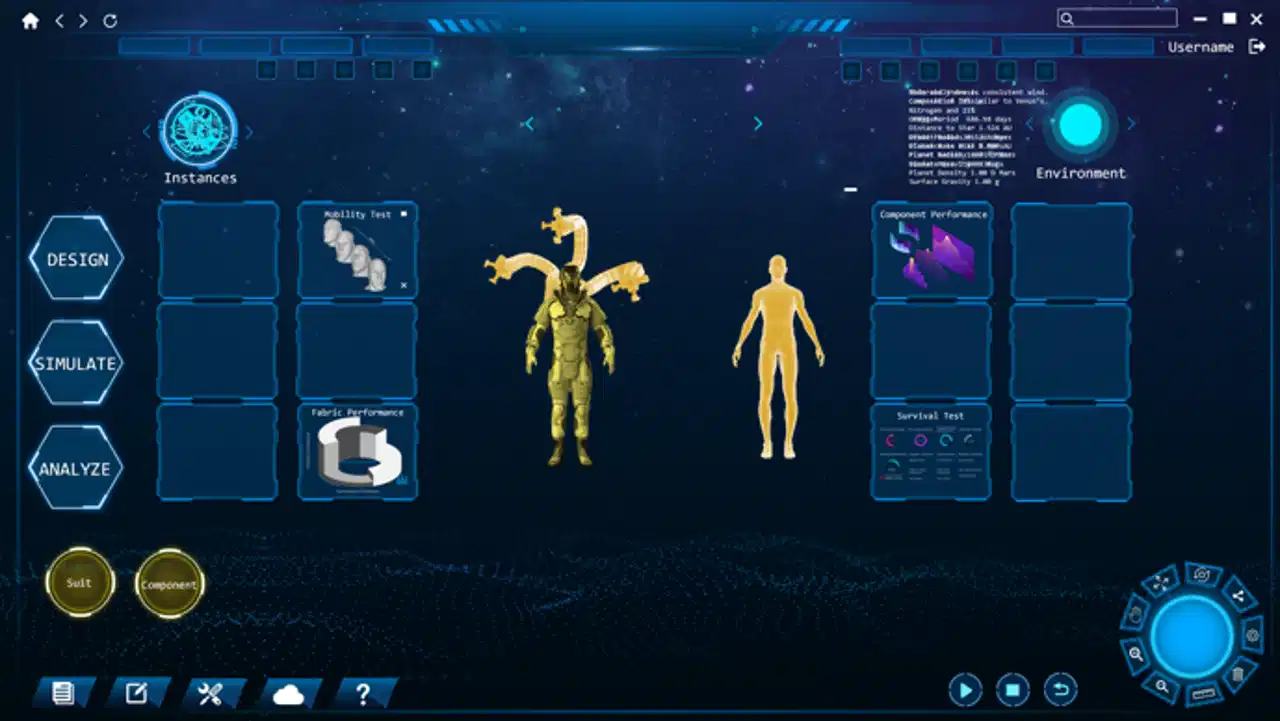
Translating the iron bird concept into human systems produces a specific architecture, and it maps closely onto the three-part PROVE validation apparatus.
The structural frame
The suit is mounted in its operating geometry rather than laid flat, because relative position affects cable routing, thermal gradients, fluid flow and mechanical loading. An assembled suit tested in the wrong geometry is not the article that will be worn.
The environmental generation
SUITRIX test rigs supply the mission conditions: pressure, vacuum, thermal, hydrostatic, chemical and mechanical loading, applied repeatably and with controlled ramp rates so that transient behaviour is testable rather than merely survivable.
The occupant
This is the human systems addition that has no aerospace equivalent, and it is essential. SYNHUM occupies the suit and generates the metabolic heat, respiratory loading, joint articulation and body geometry that make the integration test representative. An iron bird without an occupant model tests the equipment; with one, it tests the human system.
The simulation layer
SYNSUIT supplies the hardware-in-the-loop element: models of the elements not physically present, prediction of expected behaviour, and the ability to inject faults and off-nominal conditions on demand. Fault injection is the capability that most distinguishes a rig from a test fixture.
WHAT TO EXERCISE ON THE RIG
The test matrix should be organised around interactions rather than subsystems.
- Combined environmental cases: thermal extreme plus pressure extreme plus mechanical loading plus high metabolic rate, simultaneously.
- Transitions: ingress and egress sequences, pressurisation and depressurisation profiles, mode changes and handovers between power or gas sources.
- Degraded modes: single sensor failure, partial power loss, communications interruption, reduced life support capacity, each singly and in credible combinations.
- Duration effects: extended runs that surface drift, wear, consumable depletion and thermal soak that short tests miss.
- Fault injection: deliberate introduction of faults to verify detection, annunciation and recovery behaviour.
The last category is where most value is generated per test hour, because it exercises the system's response logic, which is otherwise only tested by accident.
PROGRAMME BENEFITS
The aerospace experience with iron birds predicts what human systems programmes should expect. Defects move earlier in the programme, where they are an order of magnitude cheaper to fix. Software matures against real hardware behaviour rather than against assumptions. Human trials begin with a known envelope rather than as a discovery exercise. And qualification evidence accumulates continuously rather than in a compressed campaign at the end.
There is also a less obvious benefit: the rig becomes the reference article. When a fielded system behaves unexpectedly, the ability to reproduce the conditions on a rig and observe the behaviour directly is the difference between a diagnosed defect and a theory.
BUILDING THE TEST MATRIX AROUND INTERACTIONS
Because the rig exists to find interaction failures, its test matrix should be constructed differently from a subsystem qualification matrix. The organising question is not which subsystem is being tested but which pair or group of subsystems is being made to interact.
A practical method is to build an interaction matrix listing every subsystem against every other, and for each populated cell identify the physical coupling mechanism: thermal, electrical, mechanical, fluid, electromagnetic or software state. Cells with a coupling mechanism and no planned test are the programme's blind spots.
This exercise typically surfaces couplings that nobody had considered. Power electronics coupling thermally to the cooling loop. Communications radiating into biosensor channels. Mobility articulation loading a cable run that also carries a pressure sense line. Software power management altering the sampling rate that an alerting threshold assumed.
Each identified coupling becomes a test. The resulting matrix is usually smaller than a comprehensive combinatorial matrix and considerably more informative, because it targets the mechanisms by which integration actually fails rather than sampling the configuration space uniformly.
SCALING AND SEQUENCING
Full integration rigs are expensive, and small programmes reasonably ask whether the investment is proportionate. The practical answer is to scale the rig with the programme: begin with a subsystem integration bench covering the two or three subsystems with the highest interaction risk, and extend it as the design matures. The architectural discipline of testing interactions rather than components matters more than the scale of the facility.
What does not scale down is configuration control and instrumentation traceability. A small rig with disciplined records produces usable evidence. A large rig without them produces expensive anecdote, and this remains true regardless of budget.
FREQUENTLY ASKED QUESTIONS
What is an iron bird rig?
A full-scale ground-based test rig replicating an aircraft's structural framework so that flight controls, hydraulics, electrical systems and avionics can be installed in their relative positions and exercised together under simulated flight conditions. SAE AIR5992 documents the practice, which is standard across the aerospace industry.
How does the concept apply to suit systems?
Advanced suits have the same failure topology: subsystems that pass individually fail at their interfaces. An integration rig mounts the suit in operating geometry, applies mission conditions through environmental rigs, places an instrumented surrogate inside it, and runs predictive models alongside so that faults can be injected and interactions observed.
Do small programmes need a full integration rig?
No, but they need the discipline. Scale the rig with the programme, starting with a subsystem bench covering the two or three highest-interaction-risk subsystems and extending it as the design matures. Configuration control and instrumentation traceability do not scale down and matter regardless of facility size.
References
- Metakosmos - PROVE
- Metakosmos - SUITRIX
- Metakosmos - SYNHUM
- Metakosmos - SYNSUIT
- Metakosmos - CORE
- Metakosmos - DEPLOY
- Metakosmos - Human Systems Infrastructure Platform
- SAE International - AIR5992: Descriptions of Systems Integration Test Rigs (Iron Birds) for Aerospace Applications
- NASA - X-59's Latest Testing Milestone: Simulating Flight from the Ground
- Wisk Aero - Inside Wisk's Iron Bird
- NASA - NASA-STD-3001 Volume 2
- NASA HRP - Human Health and Countermeasures evidence report
Explore integration testing and the PROVE apparatus
Explore integration testing and the PROVE apparatus at metakosmos.co/prove.