
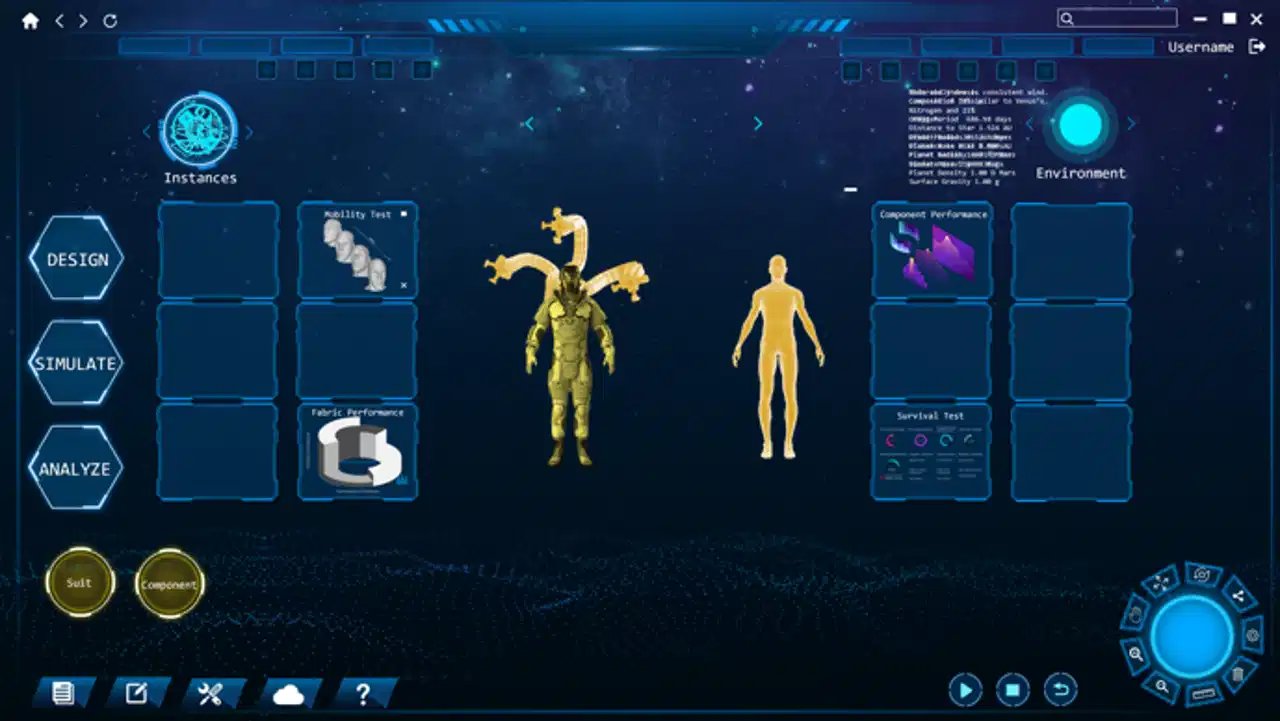
NASA-STD-3001 covers human-system requirements across design, development, test, operations and maintenance. The scope is deliberate: human systems failures do not occur in a single phase, and they do not occur within subsystems.
Human systems engineering is often reduced to human factors: the discipline that reviews control layouts late in the design cycle, after the decisions that matter have been made. The standard describes something broader. It is the discipline that treats the operator as a system element with characterisable performance, failure modes and interfaces, integrated from requirements definition onward.
THE REFRAMING: OPERATOR AS SYSTEM ELEMENT
The conceptual shift is straightforward to state and difficult to implement. Traditional engineering treats the human as an external user of the system. Human systems engineering treats the human as a component within the system, with specifiable performance parameters, degradation curves and failure modes.
This means the operator's cognitive load budget is a design constraint in the same sense as a power budget. Their thermal tolerance is a system limit in the same sense as a component temperature rating. Their reaction time under stress is a timing parameter. Their error rate under fatigue is a reliability figure.
Once framed this way, the questions change. Instead of asking whether the suit protects the operator, the question becomes whether the human-suit system can complete the mission with adequate margin, and how that margin is measured.
WHY THE SUIT BECOMES THE INSTRUMENTATION POINT
If the operator is a system element, their state must be observable. In extreme environments, the suit is the only thing in continuous contact with the operator across the entire mission, which makes it the natural instrumentation platform.
This is why suit hardware architecture and telemetry architecture have become inseparable design problems. Sensor placement constrains garment construction. Data and power routing constrain barrier design. Thermal management of electronics interacts with thermal management of the human. None of these can be resolved by treating instrumentation as an add-on.
The consequence is organisational as much as technical: suit programmes now require systems engineers who are comfortable across materials, physiology, electronics, data architecture and software, or they require unusually disciplined integration management between specialists who are not.
THE INTERFACE FAILURE PATTERN
Human systems failures cluster at interfaces, and the pattern is consistent enough to be predictive.
- Human-hardware. Mobility restriction, pressure points, dexterity loss, sensory occlusion. The suit protects and simultaneously degrades the operator's capability.
- Human-information. Alert fatigue, display overload, ambiguous state indication. Information intended to help becomes cognitive load.
- Human-procedure. Procedures written for nominal conditions that become unexecutable under stress, cold, or restricted dexterity.
- Human-team. Communication degradation through helmets, masks and comms systems, and loss of the non-verbal signals teams rely on.
NASA's documentation of EVA injury patterns illustrates the first category well, with hand and finger injuries dominating both training and flight because glove design sits at the intersection of pressure containment, dexterity requirement and repetitive loading.
HUMAN SYSTEMS ENGINEERING ACROSS THE LIFECYCLE
Requirements phase
Operator characteristics, anthropometric accommodation range, task analysis, workload budgets and environmental exposure limits should all be defined here. Requirements added later are constraints on a design that has already committed.
Design phase
Trade studies that include human performance as an evaluation axis rather than a constraint checked at the end. A design that saves two kilograms at the cost of ten percent more metabolic work is not obviously better, and only a trade framework that quantifies both will reveal it.
Test and validation phase
This is where the validation apparatus earns its cost. Human surrogates generate biomechanical and physiological measurement without operator risk. Test rigs apply mission conditions repeatably. Digital twins predict what both should produce. Human-in-the-loop trials follow once the envelope is established rather than being the primary discovery mechanism.
Operations phase
Continuous telemetry provides in-service data on how the human-system performs in reality, which almost always differs from design assumption. This data feeds back into requirements for the next iteration, closing a loop that most programmes leave open.
THE DATA PLATFORM CONSEQUENCE
Once operations-phase telemetry exists at scale, something structurally significant happens. The suit stops being a delivered product and becomes an instrumented asset generating a continuous evidence stream.
That stream supports condition-based maintenance rather than schedule-based, individualised readiness assessment rather than cohort-based, evidence-driven requirement refinement for successor systems, and defensible exposure and health surveillance records. Across a fleet, it also supports comparative analysis that no single-unit instrumentation can produce.
This is the sense in which the suit becomes a data platform. Not because it has sensors, but because the data it generates changes how the organisation makes decisions about people, equipment and missions.
ORGANISATIONAL IMPLICATIONS
Programmes that adopt this framing tend to require three structural changes. Human systems engineering must report at system level rather than sitting inside a specialist function with advisory authority only. Data architecture must be specified as a programme deliverable with its own requirements and acceptance criteria. And test infrastructure investment must be justified as capability rather than overhead, because evidence generation is the product in regulated markets.
The organisations moving fastest on this are typically not the largest. Established primes carry organisational structures that separate the disciplines this approach requires to merge, while smaller integrated teams can hold materials, physiology, electronics and software in a single engineering conversation.
QUANTIFYING THE HUMAN AS A SYSTEM ELEMENT
The framing only becomes useful when human parameters are expressed in the same units as everything else in the system budget. In practice this means building a small set of quantities into the requirements set at the same level as mass, power and thermal budgets.
- Metabolic budget. Expected work rate profile across the mission, with peak and sustained values, driving life support sizing and thermal rejection capacity.
- Thermal tolerance envelope. Core temperature limits, permitted rate of rise, and time to threshold under worst-case loading.
- Cognitive load budget. Number of concurrent tasks, decision points per unit time, and the reserve capacity required for contingency handling.
- Dexterity and force envelope. Grip force available through the glove, reach envelope in the pressurised configuration, and fine motor capability for the smallest interface the operator must manipulate.
- Communication budget. Speech intelligibility through the system, and information transfer rate available to and from the operator.
- Accommodation range. Anthropometric percentiles the system must fit, stated explicitly rather than defaulted to a historical range.
Programmes that carry these six as formal budgets, reviewed at each design milestone alongside mass and power, catch human systems problems at design review. Programmes that treat them as qualitative considerations catch them in trials.
WHAT GOOD LOOKS LIKE
A mature human systems engineering programme can demonstrate a requirements tree with human performance requirements traceable to verification methods, trade studies with quantified human performance axes, validation evidence generated on surrogates before human exposure, telemetry architecture specified alongside hardware rather than after it, and an operational feedback loop that has actually changed a requirement.
That last item is the hardest test. Most programmes claim a feedback loop. Few can name a specific requirement that operational data changed. The ones that can are running the discipline properly, and their next-generation systems will show it.
FREQUENTLY ASKED QUESTIONS
What is human systems engineering?
The discipline that treats the human operator as a system element with characterisable performance, degradation curves and failure modes, integrated from requirements definition onward rather than reviewed late in design. It spans the full lifecycle, covering design, development, test, operations and maintenance.
How is it different from human factors?
Human factors is often applied as a design review activity concerned with interfaces and usability. Human systems engineering sets requirements, participates in trade studies with quantified human performance axes, drives validation methodology and closes the loop from operational data back to requirements. The scope and the authority are different.
Why is the suit becoming a data platform?
Because if the operator is treated as a system element, their state must be observable, and in extreme environments the suit is the only thing in continuous contact with the operator throughout the mission. That makes it the natural instrumentation point, which in turn makes sensing architecture a hardware design constraint rather than an accessory.
References
- Metakosmos - Human Systems Infrastructure Platform
- Metakosmos - CORE
- Metakosmos - PULSE
- Metakosmos - PROVE
- Metakosmos - DEPLOY
- Metakosmos - Domains
- NASA - Human Spaceflight and Aviation Standards (NASA-STD-3001)
- npj Microgravity - NASA Space Flight Human-System Standard
- NASA NTRS - NASA-STD-3001 and the Human Integration Design Handbook
- NASA HRP - Human Health and Countermeasures evidence report
- NASA Human Research Program
Explore the Human Systems Infrastructure Platform
Explore the Human Systems Infrastructure Platform at metakosmos.co/platform.