
An intravehicular activity suit is a contingency system. An extravehicular activity suit is a primary operating environment. Everything else that separates them follows from that difference in role.
THE FUNDAMENTAL DISTINCTION
It is worn inside a pressurised vehicle during the phases where vehicle pressure integrity is most at risk — launch, entry, docking — and its job is to keep the crew alive if the cabin depressurises, long enough to reach a safe state. It is not designed for work outside the vehicle.
The EVA suit is a self-contained spacecraft around one person, providing pressure, breathing gas, carbon dioxide removal, thermal control, power, communications, radiation and micrometeoroid protection, and enough mobility to perform useful work for hours in vacuum.
PRESSURE AND MOBILITY
IVA suits typically operate at a relatively low differential pressure and are usually unpressurised in normal operation, inflating only on cabin pressure loss. Because they spend most of their operating life uninflated, mobility while pressurised only needs to be sufficient for emergency vehicle operation - reaching controls, securing restraints, egress.
EVA suits are pressurised continuously throughout their working period, which makes joint mobility the dominant design constraint. The current US Extravehicular Mobility Unit operates at 4.3 psi, and NASA research documents that the pressurised garment forces the crew member to expend energy deforming the suit, limiting mobility and contributing to musculoskeletal injuries, with hand and finger injuries most frequent in both training and flight.
This mobility burden drives the entire EVA design discipline: convolute and bearing joint architecture, volume-constant design, sizing and anthropometric accommodation, glove design as a specialised sub-discipline in its own right. EVA programme requirements are therefore substantially more demanding than IVA requirements on this axis.
LIFE SUPPORT ARCHITECTURE
IVA suits are umbilical-fed from vehicle systems in normal operation, with limited independent capability sized to a contingency duration. The mass and volume penalty of the suit is low because most of the life support function remains in the vehicle.
EVA suits carry a portable life support system: oxygen supply, carbon dioxide scrubbing, thermal control loop and heat rejection, power, water management and contaminant control. This is where the majority of EVA suit mass, complexity and failure modes live, and it is the reason EVA suit development timelines are measured in years rather than months.
The hardware architecture layer therefore looks very different between the two: an IVA suit is principally a pressure garment with interfaces, while an EVA suit is an integrated life support platform with a pressure garment attached to it.
DECOMPRESSION MANAGEMENT
This is the operational difference that most affects mission planning. An EVA at 4.3 psi from a cabin at 14.7 psi creates a decompression obligation. NASA manages this through oxygen prebreathe protocols, where the resting protocol requires four hours of breathing pure oxygen prior to an EVA that may run eight hours, producing a crew day exceeding fourteen hours.
Considerable NASA effort has gone into reducing this. Staged approaches using reduced cabin pressure with elevated oxygen fraction - for example an 8.2 psi cabin at 34 percent oxygen - can minimise or eliminate prebreathe time, saving crew time and consumables. Exercise-augmented protocols achieve similar reductions through accelerated denitrogenation.
IVA suits carry no equivalent obligation in normal operation because they operate at or near cabin pressure. This is a substantial simplification and one reason IVA systems reach qualification faster.
THERMAL AND ENVIRONMENTAL PROTECTION
EVA suits face direct solar loading, deep shadow, and no convective medium for heat rejection. Lunar surface operations near the south pole involve permanently shadowed regions where temperatures fall dramatically, alongside direct illumination on adjacent terrain. Thermal micrometeoroid garments, multi-layer insulation and active liquid cooling are all required.
IVA suits operate in a controlled cabin thermal environment. Their thermal requirement is comfort during long pre-launch periods and survivability during a contingency, both far less demanding than the EVA case.
Radiation and micrometeoroid protection follow the same pattern: an EVA suit is the outermost barrier, an IVA suit is behind a vehicle structure.
QUALIFICATION EVIDENCE DIFFERENCES
Both require human-rating evidence, but the test campaigns differ substantially in scope.
- IVA qualification emphasises rapid donning, restraint compatibility, egress performance, contingency pressurisation response, cabin interface integrity and vibration and acoustic survival through launch.
- EVA qualification additionally requires thermal vacuum performance, extended-duration life support function, mobility and torque characterisation across the pressure range, glove dexterity and hand fatigue assessment, and task performance under realistic loading.
NASA's Artemis suit programme illustrates the EVA campaign scale: pressurised underwater testing at the Neutral Buoyancy Laboratory to evaluate crew task performance during simulated lunar surface operations, thermal vacuum chamber testing, and elevated suit pressure trials assessing how crew perform tasks at different suit pressures. NASA-STD-3001 Volume 2 explicitly includes suits within its scope for human-rated systems across all lifecycle phases.
The practical implication for commercial programmes is that validation infrastructure requirements scale sharply if EVA is in scope, and that this should be reflected in programme cost and schedule from the outset rather than discovered later.
SHARED ELEMENTS WORTH BUILDING ONCE
Although EVA and IVA are distinct design problems, several elements genuinely transfer and are worth architecting for reuse from the outset.
- Anthropometric method. The sizing approach, measurement protocol and accommodation range analysis apply identically to both, and getting it right once avoids repeating an expensive and slow process.
- Instrumentation architecture. Sensor selection, data schema, time base and telemetry pipeline transfer directly, since the physiology being measured is the same.
- Materials qualification. Flammability, off-gassing, biocompatibility and cleanliness requirements are largely common and the test evidence is reusable.
- Validation infrastructure. Test rigs, surrogates and digital twin models can serve both configurations with reconfiguration rather than replacement.
- Human factors methodology. Task analysis, workload assessment and usability evaluation methods apply to both, even though the tasks differ.
What does not transfer is the substantial part: pressure architecture, joint design, life support and thermal control. Programmes should be explicit about this boundary in their planning, because the reusable elements create an impression of greater commonality than the qualification burden reflects.
CHOOSING WHAT TO BUILD
Commercial programmes should be deliberate about which problem they are solving. A crew transport or orbital tourism operator needs launch-entry and IVA capability and does not need EVA. A station operator, servicing venture or surface exploration programme needs EVA and will find that IVA capability comes largely as a subset.
The common mistake is to specify an EVA-capable suit as a hedge, absorbing the full cost and schedule of EVA qualification for a capability that will not be used. The opposite mistake - assuming an IVA suit can be extended to EVA later - underestimates that the life support system, the joint architecture and the thermal system are all different articles rather than upgrades.
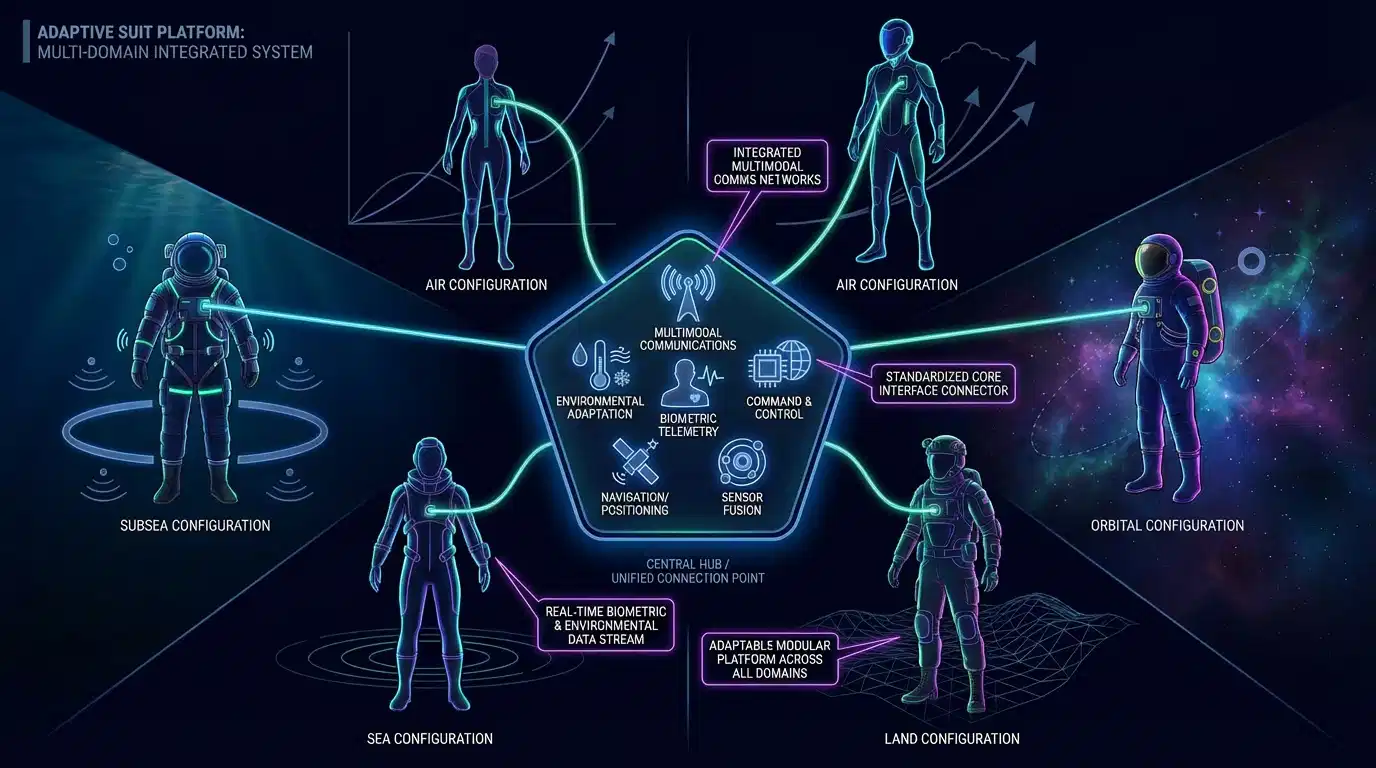
A platform approach helps here, but only if the shared elements are genuinely shared: sensing architecture, data schema, sizing and anthropometry method, and validation infrastructure transfer well between EVA and IVA. Pressure architecture and life support largely do not.
FREQUENTLY ASKED QUESTIONS
What is the difference between an EVA and an IVA suit?
An IVA suit is a contingency system worn inside a pressurised vehicle, inflating only if the cabin depressurises and providing survival until a safe state is reached. An EVA suit is a self-contained operating environment providing pressure, breathing gas, carbon dioxide removal, thermal control, power, communications and radiation protection for hours of work in vacuum.
Can an IVA suit be upgraded to EVA capability?
Not practically. The portable life support system, joint architecture for sustained pressurised mobility, and thermal protection for vacuum and solar loading are different articles rather than upgrades. Instrumentation architecture, sizing method and validation infrastructure transfer; the pressure and life support systems do not.
Which suit does a commercial space operator need?
Crew transport and orbital tourism operators need launch-entry and IVA capability only. Station operators, servicing ventures and surface exploration programmes need EVA, which brings substantially larger qualification scope, cost and schedule. Specifying EVA capability as a hedge absorbs that full burden for a capability that may never be used.
References
- Metakosmos - Space
- Metakosmos - Astronaut EVA
- Metakosmos - Launch Entry IVA
- Metakosmos - Analog Missions
- Metakosmos - CORE
- Metakosmos - PROVE
- Metakosmos - Space
- NASA HRP - Human Health and Countermeasures evidence report (EMU pressure and EVA injury)
- NASA OCHMO - Decompression Sickness technical brief and prebreathe comparison
- NASA - Spacesuit for Artemis III Moon Surface Mission Debuts
- NASA - NASA-STD-3001 Volume 2
- NASA NTRS - Designing an Exploration Atmosphere Prebreathe Protocol
Explore EVA and IVA human systems
Explore EVA and IVA human systems at metakosmos.co/space.